

























Cognitive atrophy. You know how, after spending too much time in a hospital bed, your muscles get smaller, weaker, and waste away? That’s called muscle atrophy. Cognition refers to the mental processes necessary for acquiring, processing, storing, and using knowledge. This includes other brain functions like thinking, memory, perception, attention, and language. Cognitive atrophy = your brain tissue shrinking and loss of neurons/connections, leading to impaired thinking, memory, and daily function. AI Chatbot Induced Cognitive Atrophy (AICICA) is literally a thing.
“It’s hard to think without [AI], to be honest,” junior Jay Adams said. He said, because of the easy-to-digest answers, it’s easier than sifting through internet results. As a frequent user, Adams consistently earns good grades. As a frequent AI user, he often turns to AI for homework support. “I use it so much, when I have a question and I don’t have AI accessible, it’s hard to answer the question or problem-solve it,” he said. He notices students struggle with tests when AI is not available. “It’d be cool to just not use it at all because then I’d be a lot smarter, but right now it’s not too big of a problem for me to stop.”
Research suggests that frequent AI usage and impaired critical thinking abilities are connected. The negative correlation is cause for concern that individuals who depend too much on outside sources struggle with independent reasoning or cognitive offloading, which refers to using external tools or actions to reduce mental effort. A symbiotic relationship between humans and AI, fueled by more personalized and interactive manners of engagement, could promote uncontrolled cognitive offloading or reliance.
“A lot of students using it for homework or stuff they could do themselves is kind of pointless because they know they could do it, and they’re wasting their knowledge on the technology and resources,” senior Diego Moctezuma said. “I’m not really knowledgeable either, but I want to try my very best to do stuff without having to rely on AI.”
Those who are dependent on AI prefer quickly generated solutions, engage less in deep, reflective thinking, and struggle with independent reasoning. Essentially, people who use and rely on AI legitimately can’t think on their own.
I get it. Thinking is hard, especially as a student. Why do something yourself when you don’t care, when all that matters is getting a good grade and moving on? There’s so much to do, and some of it just takes so much time. It’s easier to turn to a solution that helps so many of our peers. But this CHANGES YOUR BRAIN.
Because ChatGPT can provide instant answers to almost any query and make knowledge acquisition (because it’s not learning) feel effortless, students rely on AI for answers rather than attempting independent problem-solving. This lack of mental stimulation leads to a decrease in cognitive development and diminished memory capabilities. Gray matter density in the brain’s frontal cortex, responsible for decision-making and impulse control, can wither away! Your critical thinking skills, like the ability to analyze, evaluate, and form judgments, processes that help clearly and rationally make decisions about what to believe or do, may not fully evolve if students become overly reliant on AI.
“We’re at school to learn. I feel like we should try to do these things by ourselves because we can’t rely on AI forever,” senior Peyton Miller said. “Sometimes, I’ll use it if I’m writing an email to a teacher to make it sound more professional, but even still, that’s something that I need to learn how to do myself, not rely on AI. I need to be able to think for myself.”
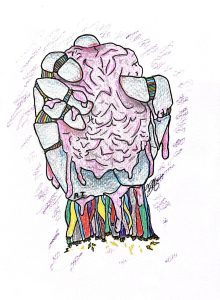
Brainrot isn’t just a joke anymore.
The prefrontal cortex, managing decision-making and impulse control, doesn’t fully develop until an individual is around 25 years old. Overreliance on AI can stunt that progress, which will impact someone for the rest of their life.
Young individuals, because their brains are still developing, are particularly susceptible to these dangerous outcomes. Synaptic pruning happens in high frequency throughout high school. Pruning is the brain’s natural and essential process of eliminating excess or weak neural connections to improve efficiency, focusing on strengthening essential ones to optimize neural networking. Relying on AI to do your homework critically undermines your abilities as a thinking human being with a brain, and you risk long-term skill stagnation.
“I think it’s melting our brains,” senior Peyton Miller said. “People around me in class… they’ll have a question for an assignment they didn’t do, and they won’t even try to think about it themselves, they’ll just immediately pull up AI to do it for them,” she said. “I catch them doing it for the simplest things, that you can definitely learn and do yourself that’ll probably help you later in life down the line.”
Letting AI bypass cognitive processes results in altered memory retention and an inability to think critically. Even using generative AI models like ChatGPT to brainstorm ideas for a research paper or other project undermines your ability to come up with ideas on your own.
By using AI, you avoid the intellectual effort to internalize concepts, which is necessary for long-term learning and knowledge transfer. As a result of this superficial engagement, students may never develop or reach an in-depth understanding of topics and face negative impacts on long-term memory formation.
“Sometimes, if I get stuck, I immediately go to [ChatGPT], and I don’t really have any other things. AI just sums everything up for you and gives you a very easy to read and process information,” junior Luke Prieditis said. “We were writing an in class essay on paper, and I feel like it was a little bit harder for me ’cause I’ve been using AI to get words and refine my writing. I do rely on it a little bit more than I should.”
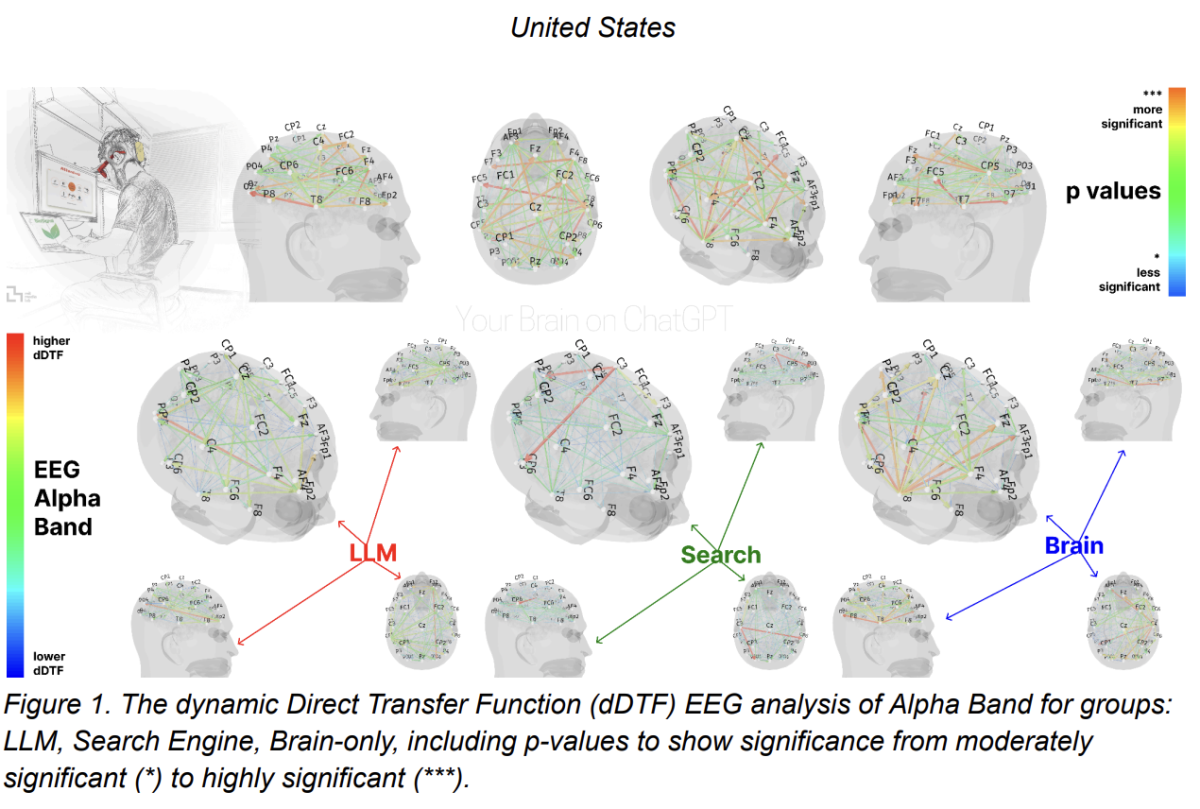
A MIT study demonstrated how AI reliance compromises individual performance and significantly impacts key aspects of learning, like retaining and recalling information.
Researchers at the Media Lab divided 54 subjects—18 to 39 year-olds from the Boston area—into three groups: one with access to ChatGPT, a second with only Google’s search engine, and the last group with nothing at all. Participants then wrote several SAT essays, four sessions per participant over a period of four months. Using an electroencephalogram (EEG) to measure electrical activity in the brain across 32 regions, the researchers found that ChatGPT users had the lowest brain engagement and consistently underperformed at neural, linguistic, and behavioral levels.
The study documented brain connectivity and engagement systematically scaled down with the amount of external support. As users increasingly depended on search engines for fact-checking and accessing information, their ability to remember specific content declined. AI users had more trouble remembering previous essay topics and experienced difficulty when attempting to quote their own work, though they could recall how and where to find it, in contrast to the brain-only group.
“I think that it doesn’t really have a place in an academic space, honestly,” senior Tatum Dick said. “I can still think critically, but I know a lot of people who will just be like, ‘Oh, write me an essay at a tenth grade level,’ or whatever. They’re not even like thinking about what they’re writing the essay about because AI is just doing it for them.”
If you stop thinking on your own, you won’t be capable of reaching your full potential after a while. That’s terrifying. The thought (ha) of drawing blanks when you try to come up with ideas is so foreign and dystopian, it makes me sick. The wealth of easily accessible information ChatGPT can provide diminishes motivation for students to learn, and destroys their capacity to retain information, as memory deteriorates due to underutilization.
“I just feel like we need to think for ourselves more than rely on technology,” Miller said. “Because we can’t rely on that. It’s just an object, not our brain.”
Sure, students might appear stronger when using AI tools, but function worse when they’re taken away because of its negative cognitive effects, ultimately compromising their performance. It’s better to never use or rely on it in the first place.
The MIT study recommended “combining AI tool assistance with tools-free learning phases to optimize both immediate skill transfer and long-term neural development” in an educational environment.
Using AI tools only as an adjunctive resource or supplement, specifically within a traditional classroom environment, may be the key to retaining our cognitive abilities. Students could ask ChatGPT to provide additional information or clarification within a lesson while still relying on their teacher as the primary facilitator of class activities, subject information, and intellectual discussions.
“I think that there’s lots of better ways AI could be used in an academic space, like [for] closed captioning for students with learning disabilities or… text to speech things,” Dick said. “I just don’t think people should be dependent on AI because it’s really unpredictable at times.”

Help can come in a variety of ways outside of AI. Khan Academy or Quizlet are options, and real, live individuals in the Tiger Opportunity Center (TOC) are available to tutor students.
“If you’re feeling drawn towards AI, my advice is to try and snap out of it and try to find someone in the real world that can help you,” Dick said, “because there’s lots of people on campus that are willing to help you.”
Moctezuma echoed the sentiment. He said asking a teacher or friend is always an option.
“Try your best to not use AI as much,” he said. “Work hard, and you’ll accomplish what you can do.”
So, for the future of humankind, (I beg you) please use the brain you have, not the one tech companies designed.