
















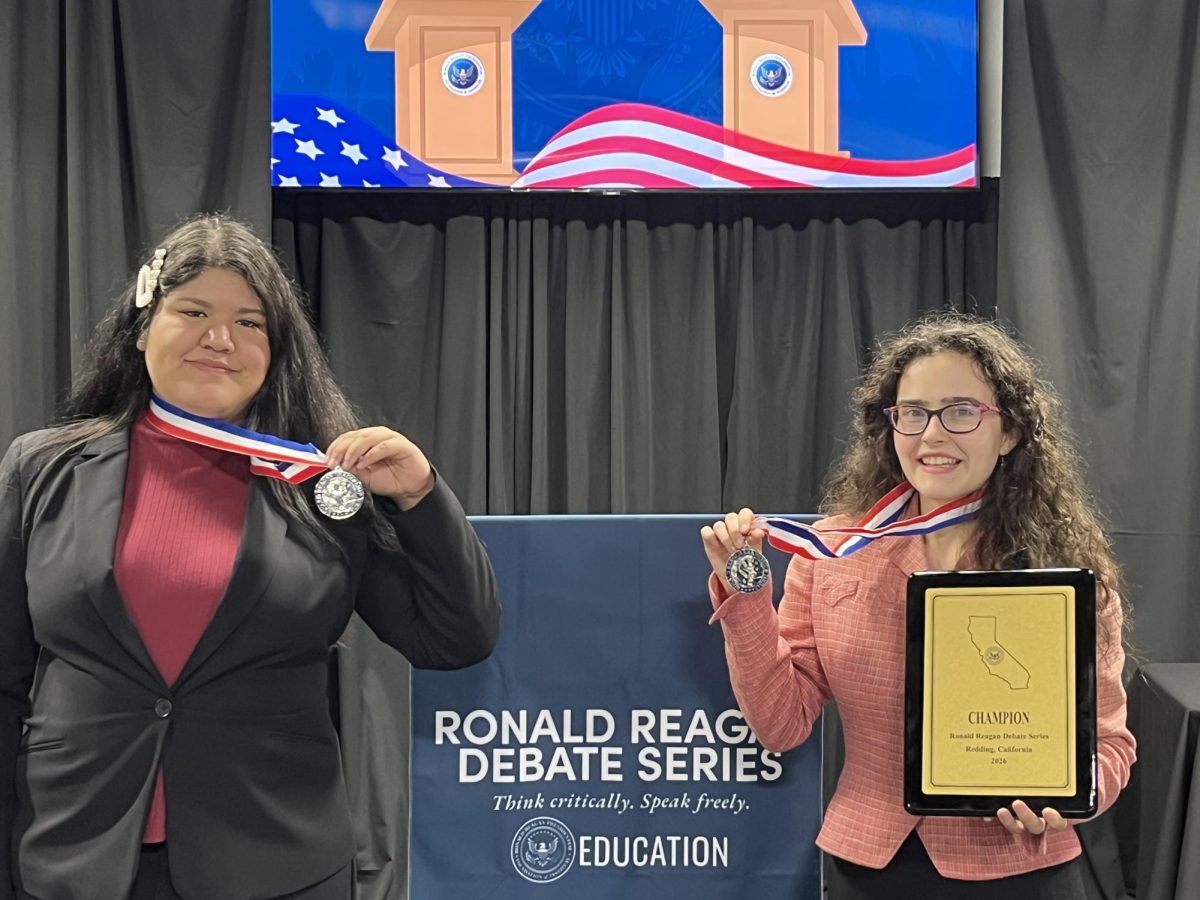



Arcata High Forensics Team competed in a regional debate series for the first time in decades this year on Saturday, April 11, and one of their members won a spot at nationals.
The Ronald Reagan Debate Series competition, run through the Ronald Reagan Educational Foundation and hosted at Simpson University in Redding, occurs in various locations nationwide. This year was the first time Northern California had a regional competition, and it was therefore accessible to Arcata travelwise.
At the competition, seniors Genevieve Caruso and Jovanna Herrera, along with junior Maria Melesio, used the presidential debate format to debate the 2026 resolution: “As the United States celebrates its 250th anniversary of self-governance, the Electoral College should be replaced by the popular vote in presidential elections.”
They competed in one-on-one, 40-minute debates through three preliminary rounds of the competition in university classrooms. Each debater was randomly assigned an opponent and a side, either affirming or opposing the resolution. Four of the seven total debaters advanced to the semi-final round, two of them from AHS.
“We all had different speeches, but we wrote the cards together, and we gave each other feedback so that everyone felt good,” President and Club Founder senior Genevieve Caruso said. “Everyone had prepped two speeches in total, so we had one per side.”
They meet every Monday until 5 p.m., alternating Tuesdays from 3:40-5, and every Friday at lunch in Room 405, totaling three to five hours a week.
Their coach, Department of Communication Studies Lecturer and Cal Poly Humboldt Debate Club advisor, Doctor Aaron Donaldson, said he was enormously proud of them all, as they tried something new, potentially fear-inducing, and made history.
“I have had other student athletes who play soccer or even football who have said debate tournaments are harder than their games,” he said. “Debate is exhausting, both in terms of how taxing listening can be, but also when it comes to the time spent speaking. It’s a sport, and it’s a tough one.”
Herrera said she kept a message from Donaldson in the back of her mind whenever she debated, that, because not a lot of individuals show up to debate, simply being present is a win in and of itself.
“As women in debate, we know that we’re held to a different standard,” she said. “There was a point for likeness to Ronald Reagan,” which they interpreted as humor, personal storytelling, courtesy/respect to opponents, and charisma, among other things, “and we knew we had to present ourselves in a different way. We couldn’t have just thrown a suit on and been like, this is what we’re gonna do. We have to be more articulate than that, and that’s what we did. The work the team put in, it all really came together in the end.”
Donaldson said that, while there are a few debate clubs, where individuals meet to learn to debate together, interscholastic debate competitions, where teams compete at other schools or go to nationals, are very rare. Until AHS started their team this year, there wasn’t a single competitive traveling high school team in Humboldt County.
“Starting a new team is hard. Sticking to it as they have the first year is huge,” Donaldson said. “Genevieve, in particular, is the first student I have met in 20 years of coaching who competed for a high school team and a college team in the same year. This is unheard of, and it speaks to her motivation, determination, and ability to receive and apply feedback.”
Caruso and Herrera debated each other in the final round. In terms of content, Herrera wasn’t worried because she found she constantly changed her original speech every time she presented it, whether it be in the preliminary or the semifinals.
“It was quite difficult, as it’s hard to feel competitive with your own teammate,” Caruso said.
In some ways, Herrera said, it was a relief knowing that she would debate her teammate, because she knew Caruso would be a better alternative than someone lacking grace. Having that sense of comfort that her opponent was someone who cared if she succeeded or not pushed Herrera even further in her performance.
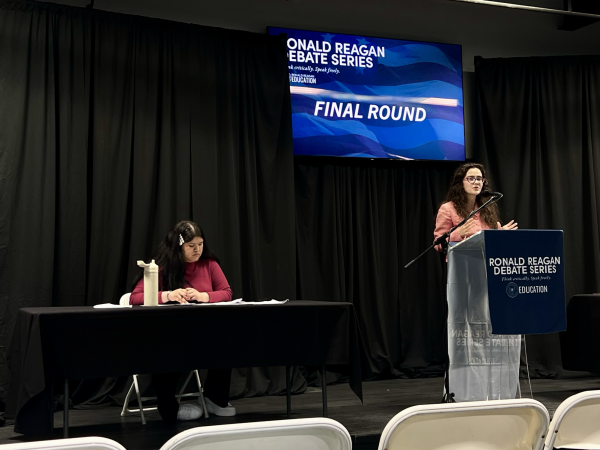
“For finals, we knew around 10 minutes after. When they announced it, I felt so excited. I did not think I was going to place that high or even get to the final round,” Herrera said.
Out of the high school students there, Herrera placed second in the competition, and Caruso placed first. As the winner, Caruso will continue to nationals in July.
“Being able to represent Arcata High and rural communities, to know that our inaccessibility doesn’t determine our outcomes, was really great,” Herrera said. “Being a woman, a Latina, and taking up space and places where historically I wasn’t allowed to, is huge for me, and I hope to continue to do that throughout my future endeavors.”