





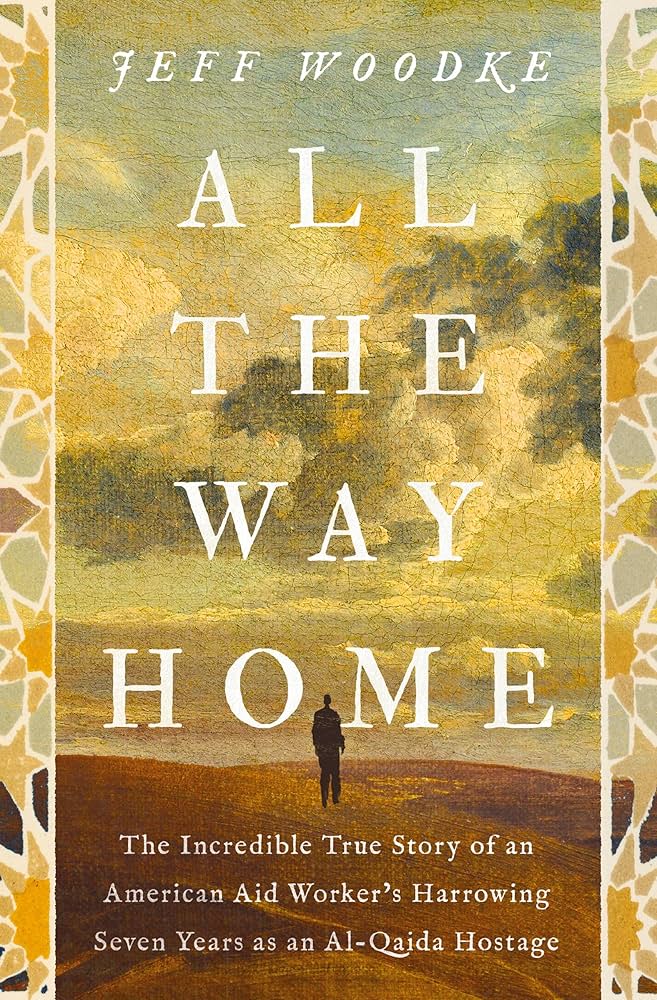





















When I first asked Jeff Woodke what sparked him to write his upcoming memoir, “All the Way Home,” he said, “this particular book, I didn’t want to write.”
On October 14th, 2016, Woodke was taken from his home in Niger, Africa, where he would not step foot on American soil until March of 2023, six and a half years later. The men who took him were a part of Al-Qaeda, the terrorist organization that executed the 9/11 attacks.
Woodke, from McKinleyville, California, was working in Niger with his humanitarian organization. Because of recommendations from the United States government, he had two armed guards and a civilian night guard protecting his home and himself from terrorists.
“[The guard] was reaching for his rifle, and I could see something, and then all of a sudden there was a muzzle flash, an orange muzzle flash,” Woodke said. “I’ve had to escape a couple of times prior when I heard they were coming, and we got away every time.”
This time, Woodke was unable to escape.
“I ran, and they caught me, beat me with rifles, trying to knock me down as I was running, and finally one of them hit my right leg with a rifle butte, and tore my Achilles tendon,” Woodke said. “They lifted me up and beat the crap out of me, stuffed me in the back of the truck, stripped me naked, including my wedding ring, and kept on beating on me.”
Woodke then spent the next six years in captivity in Mali, Africa, where he thought his life would end. Now, three years after his release, he’s telling his story.
“I’ve been wanting to write since I was a little kid, and when everything burned away, that was still there.”
The memoir releases on September 15th, 2026, one month shy of ten years since the captivity began. The book follows the experiences Woodke had in Mali and how he healed from them.
“I was pretty angry at God… and I said, ‘Well, I’m never going to pray again,’ but then I couldn’t stop praying for my family,” Woodke said. “I asked myself, ‘Why bother? Who’s even listening?’ But at the same time, I was compelled to do that because there was love. I realized that the one thing [I] got left is love.”
Over the course of six years, Woodke felt it all. He was chained, beaten, and had no sight of an out. The only thing he had was his mind.
“But I didn’t have anything to do,” Woodke said. “So I would just sit there in the shade of a tree, and I just start writing books in my head.”
He began taking the thoughts from his mind and putting them on paper.
“Writing was all that was left in me when I got out. I didn’t think I could do anything else but write.”
What Woodke went through was unimaginable. A nightmare scenario. Something many people don’t speak about after it happens, at least not with ease. But Woodke changed the narrative. This is his life, his experiences, something he wants to tell.
“You’re redefining yourself. Redefining who you are as a human being,” Woodke said. “You become a human being again because when you go through that kind of crap you’re an animal.”
“All the Way Home” is a memoir Woodke did not want to initially write, but it may have been the easiest for him to write. When Woodke arrived back in the States, he spent days in San Francisco being examined by doctors and interviewed by the FBI. When he reached Humboldt, community members rallied at the airport, welcoming Woodke home. But, he still wasn’t “home.” For Woodke, home wasn’t just the place he lived; it was something he had to achieve. A feeling he needed to reach. Woodke began writing as he arrived home. From this, Woodke has learned to talk about his time in captivity with ease.
Woodke shares his six years in a 288-page memoir, and he shared snippets with me in just 30 minutes. In just that half an hour, the world around me opened up, and everything that has and can go wrong became small pebbles on a cobblestone road.
“Even in the deepest darkness, that light still exists,” Woodke said, “you can rise from ashes, and when you think all is lost, it isn’t. You can come back, you can rise again, and love wins.”