

















Politicians. The people who represent us, whom we feel are at such a great distance from us. We watch them through a digital screen or read them from print, hearing about the laws they’re trying to pass regarding our country. But what’s it like being just feet away from the discussions?
On April 16th, at the late hour of 11 PM, I sat above the House of Representatives, as I watched them discuss and vote on the Foreign Intelligence Surveillance Act (FISA).
Around midday, my group received gallery passes. The act was originally planned to be voted on at 3:15 p.m., but was postponed by Speaker of the House Mike Johnson, with no scheduled time of voting.
At 11 pm, it was announced that the House would resume at about 11:20 PM. I, who was about to go to bed, jumped out and immediately typed in the directions to the Capitol from my hotel. 23-minute walk. Stepping outside the Holiday Inn, sitting before me, slumped up against a tree, was my ticket, a Lime electric scooter. After paying my five-dollar fee, I was off, as far as the scooter could get me to Capitol Hill. After walking maybe five minutes, I dropped my scooter off in the middle of nowhere, and I was in front of the Capitol.
It’s a different sight at night than during the day; it almost contains an eerie feeling to it. Instead of herds of middle schoolers crowding around, the only people outside the building were I and security. The building loomed over me, and it hit me: I don’t actually know how to get in.
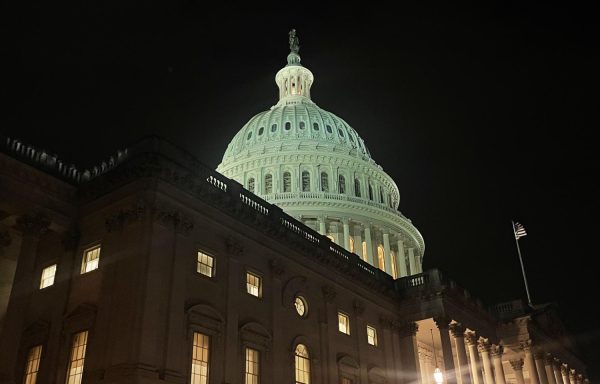
When I toured the Capitol in the morning, I entered through the Visitor Center, and upon googling how to enter the House Gallery, I was only being told to go through the visitor center, but the catch was– it closes promptly at 4:00 p.m. After a quick pep talk, I stalked my way in front of a security officer, who pointed me to a door labeled “staff only.” I opened the door, and was immediately greeted by a metal detector and security officers. After showing my credentials, aka my paper pass courtesy of Representative Jared Huffman, I had stepped foot officially in the Capitol.
The halls were quiet, and it felt more sacred than earlier. Not everyone has exclusive permission to be in this part of the Capitol, and certainly not a junior in high school. Making my way up elevators and stairs, through security, again and again, I finally reached my destination. Upon arriving at the front desk, I had to hand over all my belongings. My phone, my bag, everything. The only things that could stay with me were the clothes on my body. In exchange, I received yet another pass, this time a laminated pass to clip onto my clothes. Finally, after yet another round of security checks, I stepped foot into the house. At this point, I can recall it being roughly 11:30, give or take. The Gallery was empty, and as I peered down the overhang, it seemed as if the house was basically empty as well. About six representatives per party sat on their respective sides.
An indescribable feeling washed over me. Here I was, sitting above people I had seen so constantly on TV.
On the floor, arguing for their respective sides were Rep. Austin Scott from Georgia for the Republicans and Rep. Jim McGovern from Massachusetts for the Democrats.
Understanding their arguments was one thing, but fully understanding what they were arguing about was another. When you attend the gallery, you don’t get the luxury of having the bill in front of you, which in this case was 18 pages. Not only were the attendees in the gallery unknown to the paper document, but also many of the representatives.
As the representatives started filling the room, they finally got their hands on the act they were voting on.
It was shocking, to say the least, that the people voting on the laws of our country sometimes have not read the fine lines of the act.
To the left of me, people finally started filing into the gallery, a group of roughly fifteen representatives, dressed in suits and dresses. I definitely felt out of place. After a while, my group and I were approached by one of the suited men, and he asked us why we were here. After we explained, we asked him the same question. He then went on to tell us that he and the others sitting in his group all work for the Federal Bureau of Investigation (FBI), the Central Intelligence Agency (CIA), and the Department of Justice (DOJ). It was mind-boggling; there were federal workers, who this amendment directly affects, but it put this into a different perspective, that the way this vote goes can directly affect the way the agencies run overnight.
The first vote went live to amend the FISA Amendments Act of 2008, and only half of the representatives were in attendance. It felt as if I was there for all an eternity, waiting for representatives to trickle in, some even showing up in casual clothes, compared to their normal business attire. Fifteen minutes were given to vote, but, as any Speaker of the House would do, Johnson didn’t call it until the republicans had the votes they needed. Finally, by one vote, they were able to call it with 211-210, but it wasn’t a victory just yet. The amendment put forth by Scott was shot down with a 200-220 vote, and then the final vote, an agreement to the resolution, failed with 197-228.
Just after two a.m., the house called for a ten-day extension on the program, and it was over. I didn’t want to leave my seat. Despite spending three hours, mainly just watching people walk around and through some votes on a board, it was the most ecstatic thing I have ever witnessed. There’s a huge physical gap between the US and our politicians, but here they were, just mere feet in front of me. As we were escorted out of the Capitol, Congressmen would pass by us, security was everywhere, and we were really in the mix. Before stepping out of the eyeview, I looked back at the Capitol one last time. An eerie feeling washed over me at the remembrance of sitting in that room, watching something that had been stuck on a television screen, turned into real life.