




























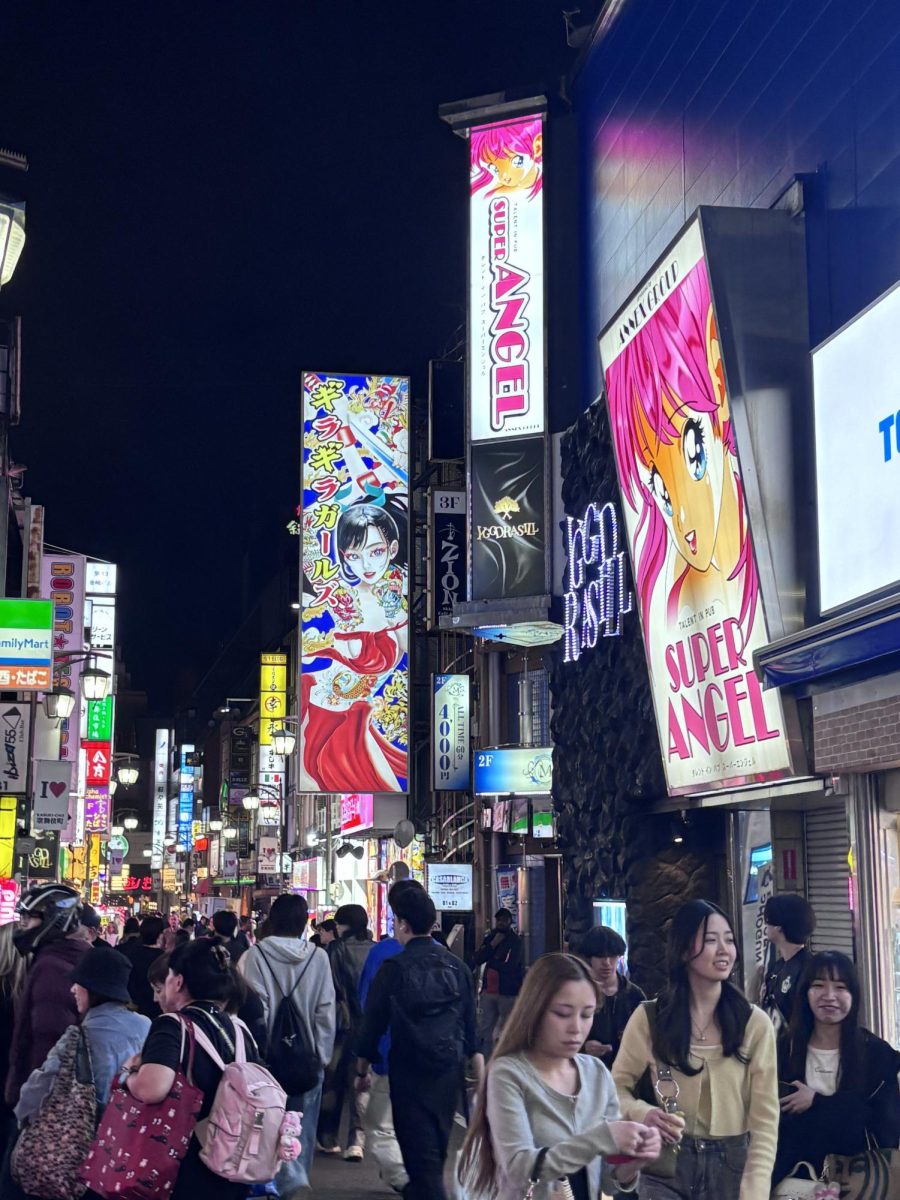
Swimming against hordes of people in the largest city, renowned for its society and cultural advancement, lives a seedy underbelly that few people recognize.
The Japanese archipelago is known for its beautiful and rich culture and tradition, from
towering cities of neon signs and flashy nightlife to the more rural, traditional streets and temples. Japan is a gorgeous country that I had the privilege of traveling to this year.
While in Japan, I was able to see a side of society that surprised me. Not that it was anything new, but because no one seems to talk about it, or even criticize it.
People tend to view other countries and cultures outside of their own as better, to the point where it can become glorification. This is called xenocentrism, where someone prefers another foreign culture over their own and sees it as superior.
The idea of xenocentrism isn’t inherently a bad thing. Respecting, finding interest, and sharing culture is a magnificent thing. But where the practice gets muddy is when people devalue their own culture and romanticize another.
When people talk about Japan, it is the latter. This is where the importance of travel comes in.
Researching and hearing about a foreign place is drastically different than experiencing it. Everyone’s experience will be different, and that is important to take into account, rather than forming an opinion of what the collective perspective is. This is why travel is so significant to understanding culture.
When I went to Japan, I tried to expose myself to the society around me without any preconceived opinions or judgment. Pretty much a blank slate. I would try to explore areas I was unfamiliar with and just walk around in the early morning and late at night. Going through each alleyway, every small corner store, and mom and pop restaurants, what I found was not what I was expecting.
I would see these giant DVD buildings that advertised pornography of young girls, and some were even placed in scantily clad school uniforms. You can even see it in fashion and makeup. The beauty standard that is fairly common is being young and cutesy. It’s downright disturbing.
Each morning in Shinjuku, I walked around the hotel’s neighborhood. What I saw were businessmen waiting for their transportation with a tall can of -196, a vodka seltzer, at 7 in the morning. Whatever gets you through your day–can’t judge them too hard. But more than that, people passed out in front of apartment entrances, girls threw up outside of a 7/11, drunken and public sexual misconduct, the list goes on.
If this is openly occurring, why is nobody talking about it?
Some of the more urban cities of Japan are, in my opinion, the epitome of, lady in the streets, freak in the sheets. Everyone that I spoke to about my travels similarly didn’t expect that. They seem so perfect.
This makes sense, as after WWII, Japan’s goal was to move away from the fascist, militarized state to be perceived as a friendlier country. This came with a denial of their past actions during WWII and throughout history. In the media after World War II, Japan romanticized its war crimes as patriotism. This image of a perfect, patriotic country is heavily draped in propaganda to help foreign nations to forget Fascist Japan’s destruction and atrocities.
People tend to sugarcoat poor societal norms of Japan because foreigners can tend to fetishize, in extreme instances, the Japanese race and Asian people as a whole. The best way to put it is, the way people praise Japan is like pretty privilege. It’s a beautiful country, full of beautiful culture and people, and highly influential media and pop culture. It is difficult to see the wrong in the beautiful, so it gets ignored.
This isn’t to say that this country is horrible and not worth its praise. It was one of the most gorgeous places I’ve been to. I love the culture, the religion, the people. It is so connected to tradition as well as respect for their country and what it holds. As well as the art, it’s inspiring and jaw-dropping. I have met the sweetest folk while traveling around this city. Japan and what it has built its society to be is so admirable. There is such a strong sense of community, pride, and collectivism that the U.S. severely lacks. I would go back in a heartbeat if I could. What I experienced doesn’t reflect the country as a whole, but it doesn’t erase the fact that it is common and normalized in certain hot spots.
It is important to criticize and understand that nothing will be black and white. Without this, change cannot occur. No country will ever be perfect. Thinking about the U.S, if no one called out our plethora of issues, we would be stuck in our same cycle of cultural disparities. Idolization of a whole country and culture leads us to reinforce harmful societal issues. Not only that, but much of the idolization, especially from a Western standpoint, leads people to infantilize Japanese communities and people, as well as the continuation of racial stereotypes.
Travel allows us to look at the good and bad of certain areas and countries, to show that no one is above the other, to invoke social change and understanding. Travel pushes us to think outside of our Western stereotypes and ideologies. It is freeing to experience other cultures separate from what the majority opinion is.
