





























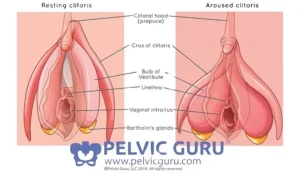
The tip of the glans clitoris is located at the top of the vulva where the inner lips meet. Varying in size, the clitoris extends inside the body, back, and down on both sides of the vagina. This part, called the shaft and crura (roots and legs), is about 5 inches long. The clitoris is made of spongy tissue that becomes swollen during arousal and has thousands of nerve endings — more than any other part of the human body. Its main purpose is for pleasure. The internal aspect of the glans clitoris was first sonographically mapped in 2009, supplying us with the full 3D image we have today, though the technology to do so was accessible to researchers for years.
Throughout sexual education, girls receive surface-level knowledge on a variety of topics, dictating what to do with their bodies as they mature during puberty. The California Healthy Youth Act, in effect since January 1, 2016, requires school districts to provide students with accurate, inclusive, and comprehensive sexual health education and HIV prevention education at least once in both high school and middle school. Among its primary purposes is to provide pupils with the knowledge and skills necessary to healthy and safe relationships and behaviors, promote understanding of sexuality as a normal part of human development, and to ensure pupils receive integrated, comprehensive, accurate, and unbiased sexual health instruction, as according to the California Department of Education. Although these guidelines attempt to educate indiscriminately, they do not address topics important to young women because sexual education is often biased, in and of itself.
Education about all sexual growth and development, not only reproduction, is integral to an individual going through puberty. In sexual education, students often see a lack of representation among male and female anatomy. One example of this is internal versus external anatomy. Students receive information about circumcision, the practice of cutting off the foreskin (often as a baby), and are shown diagrams of how both a circumcised and an uncircumcised penis looks. Health teachers inform them that penises have different shapes or irregularities when hard and normalize them.
Female anatomy information, on the other hand, is often skewed towards internal reproductive examples and excludes variation of external features. A common misconception is that all parts together are called the vagina when, in actuality, it is the internal muscular canal leading to the cervix.
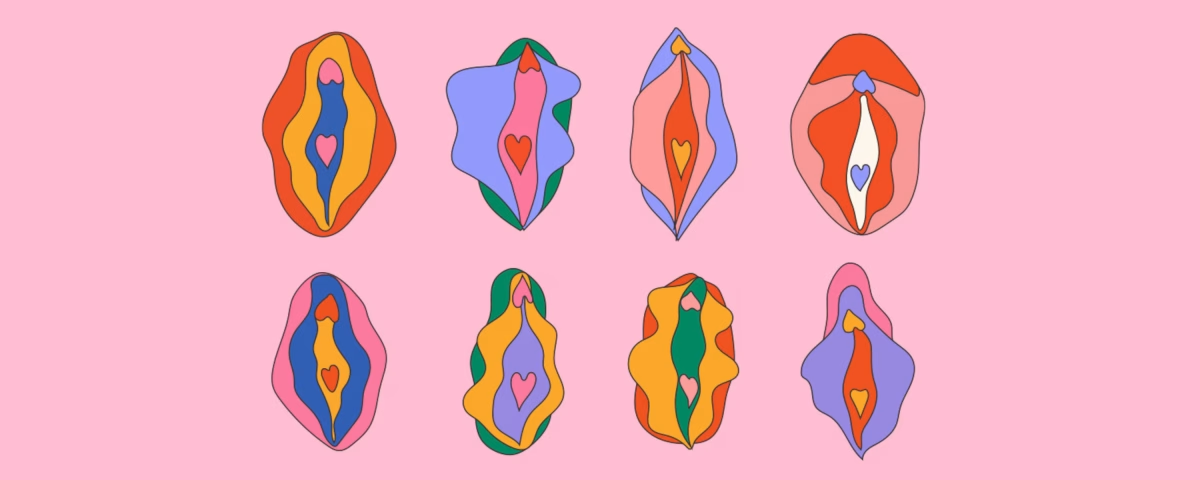
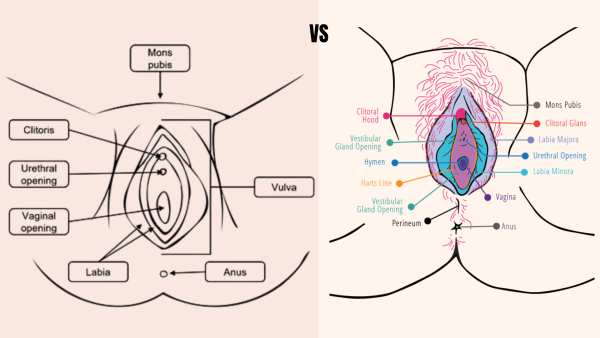
The external female genital area, including the labia, clitoris, and vaginal opening, is called the vulva. Sexual education students see diagrams of the internal workings of the vagina, but very rarely see more than one generic representation of a vulva.
Imagine, if you will, a male going through puberty not knowing that the external, visible, and tangible organ (comprising the shaft, glans, and foreskin) that they see changing is completely normal. This educational disparity between male and female anatomy can create harmful misconceptions of what a vulva is “supposed to” look like.
Students learn how males ejaculate and experience pleasure in addition to their anatomy’s reproductive purposes. “Wet dreams” and “morning wood” have limited correlation to reproduction, yet are explained, recognized as pleasurable, and normalized, as is class discussion about natural variations of semen.
Discharge, a fluid vaginal secretion that indicates a healthy reproductive system resulting from the vagina cleaning itself, is not spoken about nearly to that length.
Other issues not addressed in detail are just as significant. Among them, polycystic ovary syndrome (PCOS) is frequently misidentified, underdiagnosed, or diagnosed late. Symptoms for PCOS can start as early as ages 11 or 12, and studies say up to 70% of cases may go undiagnosed. Untreated PCOS can increase risk for conditions including Type 2 diabetes and uterine cancer. Information discrepancies regarding women’s health don’t stop there; specifically, menopause affects all women past a certain age and lacks educational representation as well.
Despite this, women’s anatomy is measured in terms of reproduction and menstrual cycles, rather than any discussion about pleasure.
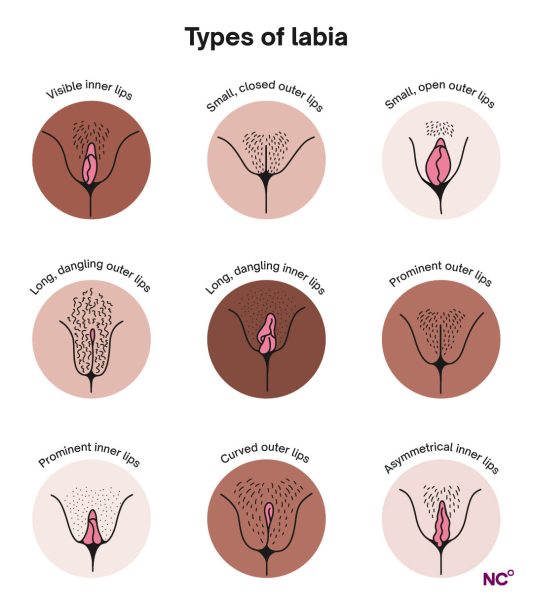
All vulvas have two sets of fleshy skin folds that encase the innermost parts of the vulva, called the labia. Latin for lips, labia are an important genital protection mechanism that offers protection from infections or physical damage to the vagina. The outer labia majora and inner labia minora are unique, varying in size, shape, and color. Pubic hair grows on the labia majora and the mons pubis, the uppermost rounded fatty mound of the vulva, directly on top of the pubic bone. The labia minora start above the clitoris, the uppermost part often referred to as the “clitoral hood,” and extend downward to the perineum, the patch of skin between the vaginal opening and anus. Each vulva and vagina produces completely normal, unique, natural scents and discharge patterns. Diagrams typically provide an overly simplified depiction of the vulva. The generic, slit‐like genital gap where the labia meet in the midline is a socially-constructed standard rather than an objective fact.
Stigma surrounding female genitalia is extremely harmful.
Labiaplasty is a common surgical procedure to reduce or reshape the labia minora. There is a “Barbie Look,” which aims for a very minimal or nonexistent labia minora. Pornography only perpetuates unrealistic expectations when it comes to genital appearance and women’s sexual pleasure. Societal pressures encourage women to be hairless, regardless of the fact that the lack of pubic hair may account for infection.
Many women find their genitalia unpleasant, and it could be a direct result of a lack of education in their youth.
Anatomy textbooks have disproportionately represented male anatomy and shown no normal variation in vulvas, or have even excluded parts of genitalia purposefully. Currently, they do not provide a realistic view of what constitutes normal in female genital appearance.
Andrikopoulou et al. (2013) analyzed one edition of 30 anatomy textbooks and 29 gynecology textbooks and found that “No anatomy textbook provided measurements for the labia minora or the labia majora … None of the textbooks included more than one picture or suggested in-text and illustration appearance variability.” This is an issue not only for sexual education purposes, but also for medical knowledge.

The glans clitoris, a female genital organ hooded by the labia minora, containing numerous sensory nerve endings, is minimized in many medical texts and sexual education programs, and was not shown accurately until 2005. The 1901 edition of “Gray’s Anatomy” partially included the clitoris, but it was taken out in the 1948 edition, likely due to Sigmund Freud’s influential belief that the elimination of clitoral sexuality was necessary to the development of femininity because it was “immature and masculine in its nature.”
Society often, perhaps as a result, places men’s pleasure as inevitable and women’s as secondary.
In popular culture, pornography objectifies women, often portraying sexual violence and submission to the male partner’s desires. Many girls subconsciously adopt pornographically normalized behaviors due to fear of rejection and judgment from societal expectations, which affects their relationship with their bodies.
“Women’s feelings about their genitals have been directly linked to their enjoyment of sex,” Peggy Orenstein writes in her novel, “Girls & Sex: Navigating the Complicated New Landscape.” In one study, she says, college women who were uncomfortable with their genitalia “were not only less sexually satisfied and had fewer orgasms than others but were more likely to engage in risky behavior… Another study, of more than four hundred undergraduates, found that early engagement in fellatio led to feelings of interiority and low self-worth among girls; by contrast, cunnilingus at the same young age was associated with greater self-awareness, sexual openness, and assertiveness… how young girls feel about ‘down there’ matters.”
Providing access and information, recognizing there are skewed expectations between boys and girls, and allowing young individuals to possess knowledge about sexual relations and health can contribute to intimate justice and safety. If teens are more secure in their knowledge, they may be more likely to advocate for themselves.
“…We’d performed the psychological equivalent of a clitoridectomy on our daughters: as if we believed, somehow, that by hiding the truth from them (that sex, including oral sex and masturbation, can and should feel fabulous) they won’t find out, and so will stay ‘pure,’” Orenstein writes. “What if the opposite were true: what if understanding one’s physical responses, truly ‘expressing your sexuality’ instead of just impersonating sexiness, could actually raise girls’ expectations of intimate encounters? What if self-knowledge encouraged them to hold a higher standard for their experiences, both within and outside relationships?”
Clarity is essential to making important decisions. It’s important for individuals who might not have access to information at home to have a way to learn about these topics. Students won’t learn if these issues aren’t addressed.