






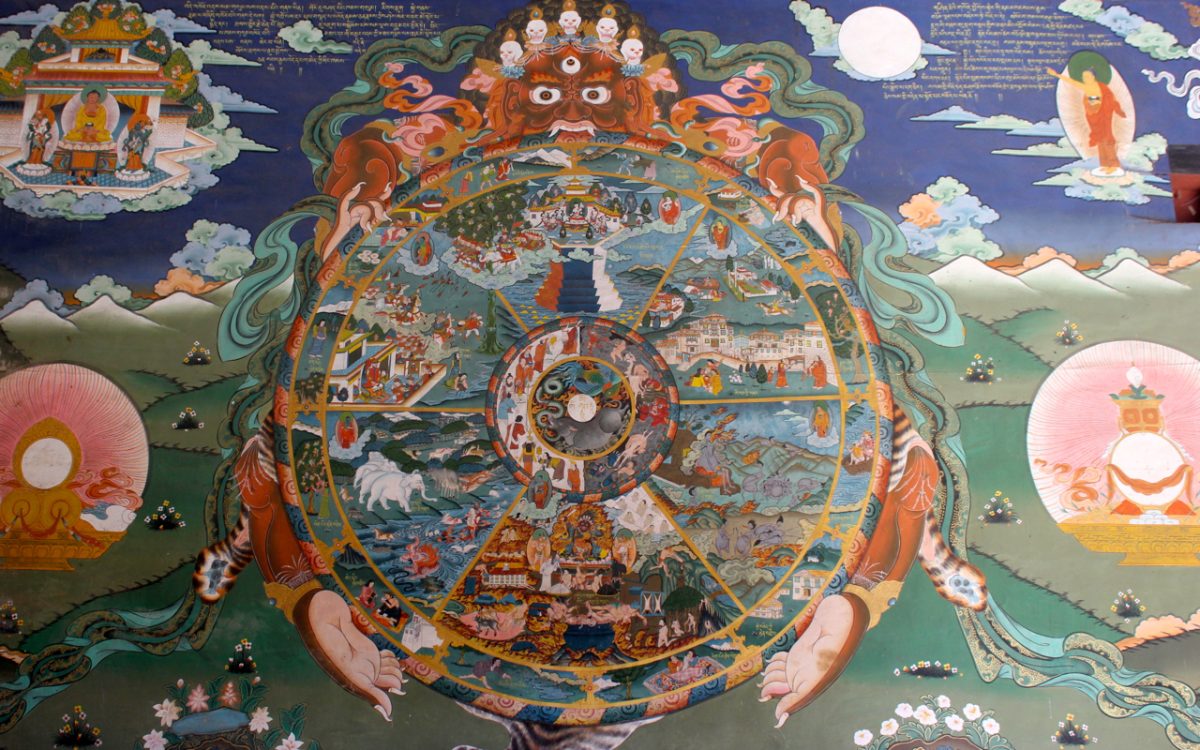









“After a time of decay comes the turning point. The powerful light that has been banished returns. There is movement, but it is not brought about by force. The movement is natural, arising spontaneously. For this reason the transformation of the old becomes easy. Societies of people sharing the same views are formed. But since these groups come together in full public knowledge and are in harmony with the time, all selfish separatist tendencies are excluded, and no mistake is made. The idea of RETURN is based on the course of nature. The movement is cyclic, and the course completes itself. Everything comes of itself at the appointed time. This is the meaning of heaven and earth.” – I Ching, “The Book of Changes”
In the past, people have looked to ancient wisdom, intuitive practices, and cultural stories to guide them. Today, we find ourselves in an unfamiliar world in which we worship our metal money machines. We pour our resources into technology, hoping that AI will save us from the ecological disaster that we have created. We are the ouroboros, eating its own tail.
Our self made gods of science, technology, and mathematics give us a complex understanding of the mechanics of individual parts, reduced to the smallest phenomena. Many medical advancements have been made towards the reduction of infectious diseases and acute traumatic injuries. We have seen declines in infant mortality and increasingly longer lifespans, which we use as an indicator of health. However, underneath the surface, there seems to be an underlying and growing sense of misalignment.
Our fundamental view of the universe is not in alignment with reality, and this imbalance has resulted in a host of symptoms evident in our world today. This building sense of crisis is a catalyst to push us into a new era of rediscovery.
The world is in a state of chaos in which division has fueled a rise in extremism and separation between people. This feeling extends into all aspects of society; from government, medicine, and the way that individuals relate to themselves and the world. We are grasping for ideas within our modern framework of thought that will allow us to piece together the universe in a way that aligns with our current beliefs. However, the facade is crumbling. It is becoming increasingly clear that we are a part of a large cultural shift that will completely rewire the way we view ideas of “self” and “other”.
Our dominant cultural paradigm is significantly rooted in ideas of individualism, scientific and rational thought, and materialism. The 17th century French philosopher Rene Descartes laid the foundation for the dominant narrative that would continue to shape our society for thousands of years. He formulated ideas of cartesian dualism, which centers around the theory of a distinct separation between mind and body. Descartes argued that reality is constructed of two fundamentally distinct phenomena: matter, which occupies space in the physical world, and the mind, which exists purely in an abstract form.
In contrast, non-dualist perspectives believe that reality is composed of a fundamental, interconnected whole. Indigenous cultures all over the globe held these animistic ideas at the heart of their cultures. Hinduism, Buddhism, Taoism, and Sufism are examples of Eastern practices that center around non-dualism as a core value. Many ancient traditions in the Western hemisphere hold similar viewpoints that encompass the deep interconnectedness of existence, the cyclical nature of time, and operate beyond the binary framework which we hold so dear in this modern, colonial world.
These patterns observed in societies that had no geographic association reflect the intrinsic nature of consciousness that we fail to accept in our post-enlightenment ideals.
A deep misunderstanding of the multidimensional aspects of health has resulted in a rampant increase in so-called “diseases of civilization”. Cancers, obesity, heart disease, Neurological disorders such as Alzheimer’s and Parkinson’s, and mental health concerns of addiction, depression, anxiety, and suicide plague our 21st century world. In the United States and other economically developed nations, we no longer suffer from a scarcity of resources. Instead, we suffer from excess, and from an extreme maldistribution of capital.
Kyla Gaskell suffered from intense “stomach migraines” persistently for years. In the hospital during the first major episode, doctors ran diagnostic tests and prescribed prescription pain killers.
“I left that experience feeling like, wow, what a waste. This was the beginning of a period of time where I was feeling pretty depressed and suicidal. I will definitely say that the painkillers did have an effect on that. Mostly, I just felt like they didn’t care. I spent so much time waiting in the hospital. I told (the doctor) I really don’t like this morphine drip, and I felt like I had no say. I felt cold and alone, which is not what you want to help you heal”.
Gaskell’s experience is just one story that echoes the sentiments of thousands who leave medical facilities feeling isolated, ignored, and alone in their suffering. Our approach to navigating health emergencies often magnifies the suffering that people pursue care for in the first place. 1 in 4 patients who seek care within the US hospital system will develop an iatrogenic illness resulting from treatment, according to a 2023 study published in the New England Journal of Medicine.
These staggering statistics are the results of operating within a system that looks at individual symptoms instead of the patient as a whole person, composed of a complexity of interrelated aspects that all contribute to the function of the body. When we distill a person’s suffering down to the smallest part, we isolate it from the whole and take it out of the context in which it formed. We rely on pharmaceutical drugs to slap a band-aid over symptoms instead of looking for a root cause. Expensive imaging and other diagnostic technologies are required to avoid potential lawsuits from insurance companies over medical malpractice and to generate funds for the hospital.
“I really felt like the focus of medicine wasn’t in the right place. It wasn’t in healing, it was in making money from surgeries or pills” said Jonathon Choi, a former neurosurgeon who attended MIT specializing in biomechanics. His experience working within the medical system resulted in high amounts of burnout and stress, eventually resulting in him choosing to walk away from medicine entirely.
Choi emphasizes the ability of individuals to self heal by taking basic, foundational steps towards wellness. This gives the patient autonomy and deconstructs the place of authority that physicians often hold. “The best thing people can do is eat a certain way, exercise, meditate, be mindful, not be stressed, hang out with their loved ones, and then their back problems will get better.”
Alternative approaches to healing are a threat to institutions foundationally based on profit. If people develop a decreased reliance on expensive drugs and medical technology, the current system will collapse. This perpetuates a system in which doctors, to an extent, keep patients in purgatory instead of encouraging foundational lifestyle changes that will lead to a reduction of symptoms.
Dr. Michael Fratkin is an active part in the movement of taking holistic values and integrating them into medicine. With over 30 years of experience as a palliative care physician in Humboldt County, he works with patients with chronic illnesses and people who are approaching the end of their lives.
Fratkin discusses how he navigates the idea of death within a culture that broadly rejects the unknown.
“Somehow we think that if we just throw a little more duct tape on the situation, we’re going to cheat death. We live with that illusion our whole lives and find ourselves surprised when we actually begin our dying process. It’s as if nobody ever thought that maybe they would die.”
Instead of seeing death as a failure, Dr. Fratkin joins patients in their uncertainty and works through philosophical and existential questions that we typically separate from physical well being. The division of therapeutics into strict psychological and physiological categories has led to a severe handicap in developing a complex and nuanced understanding illness. This Cartesian division has prevented medical practitioners from recognizing and researching the effects of different emotional states on the body’s physical health.
Discoveries in new physics are beginning to deconstruct the current dogma of science. As contradictions and complexities emerge, the framework in which we understand the world is shifting. As the philosopher Thomas Kuhn proposed in his 1962 book The Structure of Scientific Revolutions, scientific progress unfolds in a series of three major phases. First, scientific discoveries progress as a stable progression of thought, with any inconsistencies being ignored as pseudoscience or mistakes. As the emergence of anomalies increases, they create instability and a general state of crisis as deeply held beliefs are questioned. Finally, a new paradigm is constructed that reframes ideas of science to fit within the newly constructed framework of ideas.
As we find ourselves in the midst of a cultural rewiring of what it means to be human, we must embrace the unknown and deconstruct ideas that are deeply ingrained in how we understand the world around us. Welcome the unknown into your life and accept that we will never have all the answers.
As you step back into your life, I will leave you with some words of advice from Dr. Fratkin to navigate these complex times and take your health into your own hands.
“Breathe. Pause. Prioritize your well being. Explore what your life is revealing to you. Get off the treadmill for a moment. Pay attention to the world around you. Recognize the power and meaning of relationships. Love yourself before you start to adventure off into loving other people. Be brutally honest with yourself, with all the ways that you act like an idiot, you know, because you do. Because you’re human and you make all kinds of mistakes. Learn how to shed shame. We’re so privileged to be alive at all in this wild, vast, mysterious universe. That we get to be conscious beings in relationship with other conscious beings in this current moment is a truly amazing thing”
