

























Everything you consume in high school plays a role in shaping who you become. This is a stage in life where people discover their identities, values, and self-worth. For this reason, relationships, whether romantic or not, can deeply affect a person’s mental and emotional well-being.
The word relationship does not always refer to dating; it can also include friendships, classmates, and siblings, connections that can be just as influential, and just as harmful when they become unhealthy.

According to Grown and Flown, a digital resource and community for parents of teens and young adults, 1.5 million teens each year experience toxic or abusive relationships. Despite this, many toxic behaviors go unrecognized because they are often normalized or romanticized. For example, a lot of people think jealousy or controlling behavior is just part of caring about the other person, so they don’t see it as a red flag.
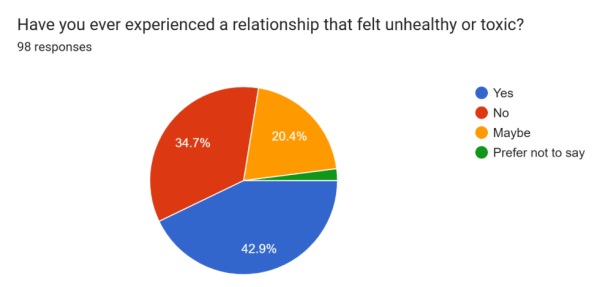
To understand how toxic relationships affect students locally, we conducted a survey of 97 Arcata High School students. The results show how widespread the issue is: 82% of students have witnessed a friend in a toxic romantic relationship, 81% have witnessed a toxic friendship, 20% said they may have been in a toxic relationship, 43% have experienced a toxic relationship.
A toxic relationship is one that consistently harms your emotional or mental well-being rather than supporting it. Common characteristics include a lack of respect or trust, emotional manipulation, controlling behavior, and poor communication. While every relationship has conflict, toxic relationships are defined by repeated patterns.
Warning signs often build gradually, making them harder to notice. According to the National Domestic Violence Hotline, these signs include:- walking on eggshells to avoid conflict
– feeling guilty for expressing your needs
– being pressured to do things you are uncomfortable with
– feeling isolated from friends or family
All of these factors end up leading to an unhealthy path. However, it can be such a battle to realize this at a young age, with little to no experience in a situation like this. If you consider yourself someone who’s struggling to grasp the concept of your reality on this topic, know that you can’t beat yourself up for not knowing something that only time could teach. It is never your fault for giving someone your energy and care, no matter who it is. They probably needed it anyway.
But this is never an excuse to keep reinforcing the feeling of powerlessness that you’ve spent justifying throughout this relationship. You must always take responsibility for the role that you play in your suffering, whatever that means for you right now. It is never too late to stand up for yourself and reconnect with the parts of yourself that you may have lost on the way.
“He would just say really weird things, force me to do things that I wouldn’t want to do, and he wouldn’t listen to my words,” junior Sonja Vevoda-Whalig said.
Recognizing a toxic relationship does not automatically make it easier to leave. Emotional attachment, dependence, and hope for change can keep people stuck.
“I think you might find more peace in just letting it go and practicing acceptance rather than trying over and over and over again,” senior Gabby Cavinta said.
Friends often notice the warning signs before the person in the relationship does. Several students shared that their friends played a major role in helping them recognize unhealthy dynamics.
Leaving a toxic relationship is not the end of the struggle. Many students shared that healing involved rebuilding trust, confidence, and boundaries.
Toxic relationships, romantic or platonic, are a real issue in high school, but they do not have to be accepted as normal. If a relationship makes you feel controlled, unheard, or unsafe, it is not love, and you deserve better.
Getting out of a toxic relationship is hard, especially when you still care about the person. The first step, be honest with yourself about how the relationship makes you feel. It helps to make a plan and talk to someone you trust, like a friend, parent, or anyone who you know will listen to what you have to say. Supporting someone in a toxic relationship can also be difficult, and patience is often necessary.
“Don’t be judgmental. Like, just listen to them and try to understand where they’re coming from. It takes time, so just be open,” senior Flora Shaw said, offering advice to family members and friends trying to help.
When you end the relationship, you don’t owe a long explanation. Saying something simple and clear is enough. Afterward, limiting contact can help you heal and avoid being pulled back in. It’s normal to be sad at first; let yourself have time to overcome it. Don’t try to rush this process. If there is any time to be extra kind to yourself and your feelings, it is now. Your nervous system will heal itself as long as you allow it to.
“I think one day you just wake up and you realize you’re done with it,” Cavinta said.
Ultimately, toxic relationships should not be accepted as a normal part of high school life. Relationships should make people feel respected, supported, and safe. So if a relationship leaves you unheard or controlled, it is okay to just walk away.
“Prioritize yourself, learn, and realize that you need to give only as much as you get,” senior Avery Wassenaar said. “If nobody’s giving you anything in a relationship, and it’s all one-sided, and you’re giving them everything, and they’re not willing to give you anything back, that’s maybe not the relationship for you.”