



























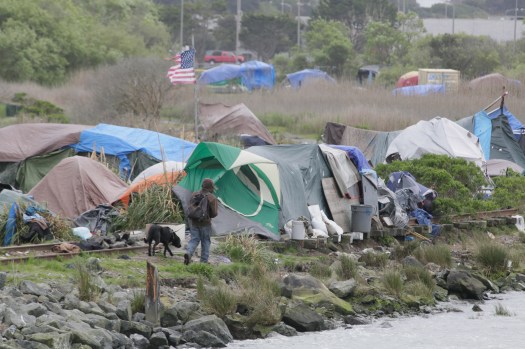
The sight of people with cardboard signs asking for money, food for themselves or their dog, or simply reading “anything helps” is accepted as a part of life behind the redwood curtain. Houselessness is far and away one of the county’s most infamous problems. It is not an uncommon occurrence to see people identifiably houseless throughout the Arcata plaza, near the crabs baseball field, or in many separate parts of Eureka.
Statistics back up the prevalence of this problem as well. According to a recent 2024 count by the Department of Housing and Urban Development known as a Point in Time count (PIT), 1,573 people were experiencing houselessness in Humboldt County. Given a total county population of 132,380, that means around 1.2 percent of people living here were homeless at that time.“For people that are addicted, we don’t get much help with that,” Bear said, a man, currently houseless, living with his dog Bruce in Eureka. “I’ve had my dog over a year now. Not very many people except dogs for housing and housing programs.”
1.2 percent of a county’s population, being in similar housing situations as Bear, is the highest percentage in the state among any county: a higher percentage than San Francisco County, a higher percentage than Los Angeles County.
Also, homelessness percentages are poorly tracked county by county since PIT counts do align strictly with county borders in many places nationwide. Instead they use “continuum of care regions,” which occasionally don’t line up with county lines one to one. Given this lack of reliable data, Humboldt may have one of the highest per capita homelessness rates in the entire country, if not the highest.
So yes, Humboldt County homelessness is a real problem. But in many people’s view it’s only an issue of aesthetics, of how hard it is to look at or how uncomfortable it might make them feel to drive by someone holding up a sign without having any money to give them.
There is also the common notion of the stereotypical homeless person. Someone who simply is too lazy to work or get a job. Or someone who mooches off county or state services.
But are these concepts at all accurate? Do they reflect the real life reasons for houselessness? And why does Humboldt have such an astronomically high per capita houseless rate?
A chronic lack of affordable housing is repeatedly cited as the biggest reason for why houselessness is so prevalent here. That along with general poverty, crime, poor health, family violence, mental illness, substance abuse, incarceration, and divorce. Many times it is only one of these that trigger houselessness. Other times, it can be a combination of these factors.
Notably, a now old but still prevalent 2015 report by the Humboldt County grand jury had many criticisms of local houseless services and the coordination between them.
Among the many houseless services provided, there is very little coordination between organizations to face this problem head on.
According to the report, “Such oversight and coordination would decrease duplication of effort, increase efficiency, save tax dollars, cut costs for providers, and create a revenue stream for affordable housing… There is a critical lack of affordable housing in Humboldt County.”
First hand accounts of services back much of this up.
“I have a disability in learning, reading, writing,” Bear said, “It’s hard to fill out applications (for housing). So that’s the hard part for me there. Food wise they are helpful, it helps out. Housing wise though, for people that are disabled… it could be more helpful.”
Bear wasn’t the only currently houseless person who had critiques of Humboldt County services. “Just food services really,” Richie said, a houseless man from Connecticut. He also currently resides in Eureka. “they help somewhat with housing, but not as much as they help with food… they should be making sure everyone has somewhere to live.”
Richie had some ideas of his own on how the county could offer more housing. “The other way they could help is I see there are a lot of vacant hotels in this area, and they’re not even open, they could just open them and they could house the homeless. It would make a lot more sense than it just sitting there.”
It would likely not be as easy as Richie says, to simply open vacant hotels and turn them into shelters. Yet, his sentiments about the current services reflect complaints common among other houseless people like Bear.
One person had an even more damning thing to say about homelessness services here.
“No, nothing that I could speak to,” said a houseless man from Sacramento when he was asked if he had seen any services for the houseless at all.
Out of all the people that we spoke to for this article though, this man in particular struck something in me a little differently. He was sitting beside the exit out of the McDonald’s drive through on 4th street in Eureka. He held up a sign, it was tipping over though because he was falling asleep.
When I approached to ask if he’d like to talk about his current situation, he openly accepted. However as the conversation progressed, he got more and more visibly tired. I attempted to make all my questions for everybody as respectful as I could. But, he seemed particularly embarrassed that a group of teenagers on the street were talking to him, because apparently, his personal hardships are noteworthy enough to warrant that.
At that moment I realized I might feel the same if I were in his shoes and I were being questioned by three high schoolers.
My last question was, what he might say to a kid with more privilege who might believe homeless people are only homeless because they are lazy. All he replied with was, “I tried the other sh*t,” in reference to an attempt at a ‘straight and narrow life’.
I had no doubt that he had, he’d shared he had a very difficult upbringing in Sacramento; and oftentimes, an attempt ‘pulling yourself up by your bootstraps’ does not always work in reality.


Shawn • Dec 18, 2025 at 7:37 pm
I spent almost 20 years in prison. While I wasn’t guilty of everything I’d been accused of, I was guilty of enough to merit the imprisonment. When I was released, the only things I had were the clothes on my back and a dream. It has now been slightly more than 3-years since my release. During that time, I have become a manager at a local establishment, started two separate businesses, paid off the travel trailer I live in, bought a brand-new car, and today, signed papers to purchase a piece of property. My homelessness wasn’t a choice, but getting out of it was. The difference between myself and many of the individuals who remain homeless is that I was willing to make the sacrifices needed to get into a place, I was willing to put in the work, and to comply with the requirements needed to get myself off of the streets. For many of the people who remain homeless, they do so because they openly choose that lifestyle, whether because they are in the throes of addiction or because they simply do not want the responsibility. And why shouldn’t they choose it? There is a never ending line of people driving to their location to offer free food, clothing, blankets, even tents for them to live in. Never mind the fact that these items are sold or traded for drugs, often within minutes of getting them. Was my journey easy? No, it wasn’t, but what journey is? Correction, what journey worth anything is? That said, I was determined, motivated, and had a plan. The result? I had a home of my own within a few weeks. Am I the exception? Only in that I had the determination, drive, and desire to not be homeless. Had I that same desire towards drugs and alcohol, I never would have made it off the streets. Instead, I would have turned out like the majority of the homeless you see, sitting there with a sign trying to convince people to drop a buck or two into my outstretched hands.